
Highlights:
- Integration of the proposed technologies will help address the transmission and computational infrastructure challenges faced when implementing AI agents.
- This trial verified the effectiveness of optimizing the transmission and computational processing of high-volume data handled by AI agents.
- This initiative has been selected for exhibition at the Japan Pavilion at MWC 2026, where the research findings and underlying concept will be presented to an international audience.
TOKYO, Japan, Feb 26, 2026 – (JCN Newswire via SeaPRwire.com) – The Graduate School of Engineering, The University of Tokyo (Tokyo; Dean of the Graduate School of Engineering: Professor Yasuhiro Kato; Head of the Nakao Research Laboratory: Professor Akihiro Nakao; hereinafter “The University of Tokyo”), NTT, Inc. (Headquarters: Tokyo; President and CEO: Akira Shimada; hereinafter “NTT”), and NEC Corporation (Headquarters: Tokyo; President and CEO Takayuki Morita; hereinafter “NEC”) have integrated three newly proposed technologies on a 6G(*1)/IOWN(*2) platform to realize the widespread use of AI agents(*3) supporting a safer and more secure society. Through this initiative, the three parties have combined streaming semantic communication technology(*4), AI-oriented media control technology(*5), and In-Network Computing (INC) architecture technology(*6) to optimize the high-volume data transmission and computational processing required for AI agents. The effectiveness of these technologies has been quantitatively verified through a trial, and plans are slated for this initiative to be showcased at the Mobile World Congress 2026 (MWC 2026) Japan Pavilion, where the research findings and underlying concept will be presented to an international audience.

Figure 1. Overview of the technologies integrated on the 6G/IOWN platform
1. Background and significance of this three-party collaboration
International collaboration and global standardization are vital to the advancement of telecommunications, which serves as a universal platform accessible to anyone, anywhere in the world, and should therefore be considered from a global value perspective. In recent years, the importance of safety and security has grown, as both offer global value.
To realize a safer and more secure society, the ability to quickly perceive and take appropriate action in response to disasters, accidents, cyberattacks, and other rapidly evolving situations is imperative. However, relying solely on personnel and predefined rules to respond to such situations has its limitations, making the use of AI essential. Utilizing AI agents enables autonomous, real-time perception of the situation at hand, helping to prevent potential damage and minimize the impact of any damage that does occur.
Meanwhile, next-generation ICT infrastructure capable of processing and transmitting massive amounts of data with low latency and high reliability is vital to enhancing the functionality of AI agents.
Against this backdrop, The University of Tokyo, NTT, and NEC—all three of which possess strengths in 6G and IOWN—have united under The University of Tokyo’s Social Cooperation Program to conduct research and development on 6G and IOWN platform technologies to realize AI agents supporting safety and security.
2. Research background
While the use of AI in recent years has primarily centered on models that act based on human prompts, the utilization of AI agents capable of acting autonomously based on sensor data and other non-human-originated inputs without relying on specific instructions from human operators is expected to become increasingly common in the society of the future. In turn, these advancements will enable the realization of AI agents that support safety and security by continuously collecting and monitoring data from the surrounding environment and responding in real time when signs of abnormalities are detected.
However, the expanded use of continuously operating AI agents will cause the amount of multimodal data(*7) to skyrocket, and existing ICT infrastructure is not equipped to support such a drastic increase in data due to the technological challenges listed below.
(1) Insufficient wireless bandwidth
Continuous transmission of vast amounts of data from countless sensors and devices makes it difficult to secure sufficient wireless bandwidth.
(2) Increasing computational load due to round-the-clock AI processing of sensor data
If all sensor data is continuously processed using computationally intensive AI, it will cause an excessive computational load, making it difficult to respond in real time.
(3) Increasing computational load and power consumption with large-scale AI
Large-scale AI is required to analyze a wide range of sensor data, thereby increasing the need for computational capabilities and electrical power.
3. Technology highlights
In this research, the three parties proposed the following technological approaches to resolve the aforementioned challenges.
(1) Streaming semantic communication technology (The University of Tokyo)
This applied form of semantic communication detects contextual changes and transmits only semantic differences, thereby reducing wireless communication resources dramatically.
(2) AI-oriented media control technology (NEC)
Assigning a data identifier to an AI agent and then selectively feeding only key sensor data to the AI agent reduces the computational resources required for inference. Learning inference results from the AI agent, the data identifier is able to identify critical sensor data.
(3) In-Network Computing (INC) architecture technology (NTT)
Rather than relying on a single massive AI model, highly efficient and reliable AI processing is made possible by combining small, specialized AI distributed across the network with external information sources.

Figure 2. Technological challenges and the proposed approach
4. Trial Overview
This trial was conducted to verify the impact of the proposed technologies in terms of reducing latency through the improvement of transmission and computational processing efficiency, taking into account the characteristics of end-to-end latency(*8) (E2E latency) when using AI agents. In this trial, a video dataset including critical situations (60 seconds; 1,800 frames) was used to conduct a phase-by-phase evaluation of the configuration with which an AI agent processes video input from sensors. The intended use cases are scenarios requiring real-time performance where an AI agent continuously monitors the surroundings of a user wearing augmented reality (AR) glasses to identify environmental and contextual changes that can be used to predict and assess risk indicators.
First, the latency characteristics in a configuration where all frames fed from a sensor were sequentially processed using AI were assessed as a preliminary evaluation. The results confirmed that processing wait time increases cumulatively with each frame, resulting in a tendency for E2E latency to build over time. This implies an increase in the amount of time it takes from the occurrence of a critical situation in front of the user until assessment results and guidance are provided, thus revealing that this could pose an issue in use cases involving real-time AR assistance.
Next, on the basis of the results of the preliminary evaluation, a system configuration was assessed in which the proposed technology was applied in this trial. The evaluation confirmed that both communication traffic and computational load were reduced, and that E2E latency could be maintained at an almost constant level throughout the entire video stream. In addition, no tendency was observed for processing wait times to increase cumulatively. Furthermore, no degradation in AI inference accuracy was detected as a result of applying the proposed technology. These results demonstrate that, for this use case, which requires real-time performance, the proposed technology can stably reduce E2E latency while maintaining AI inference accuracy.
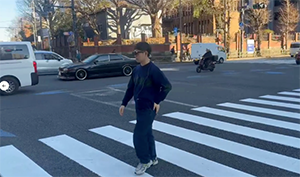
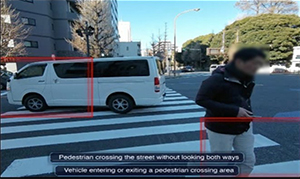
Figure 3.1. Use of AR glasses in the trial Figure 3.2. AR glasses display
5. Roles and Responsibilities
(1) The University of Tokyo:
Responsible for research and development of streaming semantic communication technology, primarily contributing to addressing technical challenges related to bandwidth constraints in wireless network segments.
(2) NEC:
Responsible for research and development of AI-oriented media control technology primarily contributing to addressing the technical challenge of increased computational load resulting from continuous AI processing of sensor data.
(3) NTT:
Responsible for research and development of In-Network Computing (INC) technology, primarily contributing to addressing technical challenges related to increased computational load and power consumption associated with the scaling of AI models.
Through the interaction and integration of each party’s technologies, the collaboration has also enabled contributions to addressing additional technical challenges beyond their primary areas of responsibility.
6. Future outlook
This initiative has been selected for exhibition at the Japan Pavilion at MWC 2026, where the research findings and underlying concept will be presented to an international audience.
Going forward, with a view toward the social implementation of the research findings, the three parties will accelerate research and development aimed at realizing AI agents and next-generation ICT infrastructure that support safety and security.
Notes:
*1.6G
6G (sixth-generation mobile communication systems) refers to next-generation mobile communication technologies currently under research as the successor to 5G. In addition to ultra-high speed, ultra-low latency, and high reliability, 6G is expected to provide a communications infrastructure designed to support massive device connectivity and AI-native applications.
*2.IOWN (Innovative Optical and Wireless Network)
The IOWN concept envisions a network and information processing infrastructure, including end devices, that optimizes both individuals and systems as a whole based on diverse information. By leveraging innovative technologies centered on optical communications, IOWN aims to provide ultra-high-speed, large-capacity communications and vast computational resources.
*3.AI Agent
An AI agent is an AI technology that understands objectives based on surrounding conditions and input data, and autonomously makes decisions and takes actions to execute tasks. In addition to conventional AI systems that operate based on human-issued instructions (prompts), growing attention is being given to AI agents that continuously perceive and assess their environment using non-human-originated inputs, such as sensor data.
*4.Streaming semantic communication technology
Semantic communication is a communication method that focuses on the meaning and importance of data, extracting and compressing only the necessary information for transmission. Compared with conventional bit-level communication, it significantly reduces communication volume while efficiently transmitting information required for AI processing. Streaming semantic communication technology is an applied form of semantic communication that detects changes in surrounding context and transmits only semantic differences, thereby dramatically reducing communication resource usage in wireless segments.
Related publication:
Shota Ono, Akihiro Nakao, “Semantic Communication Scheme for Real-Time Video Streaming Considering Temporal Semantic Continuity,” IEICE Technical Report, March 2026 (in Japanese).
*5.AI-oriented media control technology
AI-oriented media control technology analyzes input data, such as sensor data and video, prior to AI processing and selectively filters it based on importance and necessity. This reduces the computational load required for AI inference, enabling improved real-time performance and more efficient use of computing resources.
Related publication:
K. Azuma, H. Itsumi and K. Nihei, “Similarity-based Frame Screening for Edge-Cloud In-Cabin Monitoring,” In Proc. of 2026 IEEE 23rd Consumer Communications & Networking Conference (CCNC), Las Vegas, NV, USA, 2026.
*6.In-Network Computing (INC) architecture technology
In-Network Computing (INC) is an architecture that integrates computational functions, such as AI processing, within the core of mobile networks, allowing critical processing to be completed inside the network. By effectively utilizing distributed computing resources across devices, networks, and cloud systems, INC enables low-latency and highly reliable service delivery.
Related publications:
Kentaro Hayashi, Shiku Hirai, Tatsuya Matsukawa, and Hiroki Baba, “High-Speed End-to-End Information Synchronization and Collaboration Technology ‘In-Network Service Acceleration Platform’ for the 6G/IOWN Era,” NTT Technical Journal, October 2024 (in Japanese).Kentaro Hayashi, Shota Ono, Tomonori Takeda, Akihiro Nakao, “Network and Cost-Aware Tool Selection System for MCP-Integrated LLM,” IEICE Technical Report, December 2025. (in Japanese).
Hiroki Baba, Kentaro Hayashi, Shiku Hirai and Tomonori Takeda, “Unified Control of Network and Compute Toward 6G In-Network Computing Service,” In Proc. of 2026 IEEE 23rd Consumer Communications & Networking Conference (CCNC), Las Vegas, NV, USA, 2026.
*7.Multimodal data
Multimodal data refers to data that combines multiple types (modalities) of information, such as video, audio, sensor data, and location information.
*8.End-to-end latency
End-to-end latency refers to the total time required for data to be transmitted from the source, processed at the destination, and returned as a response. It includes both communication latency and computational processing latency, and is a critical metric for AI services that require real-time performance.
About The University of Tokyo
The University of Tokyo is Japan’s leading university and one of the world’s top research universities. The vast research output of some 6,000 researchers is published in the world’s top journals across the arts and sciences. Our vibrant student body of around 15,000 undergraduate and 15,000 graduate students includes over 5,000 international students.
About NTT
NTT contributes to a sustainable society through the power of innovation. We are a leading global technology company providing services to consumers and businesses as a mobile operator, infrastructure, networks, applications, and consulting provider. Our offerings include business consulting, agentic AI solutions, managed application services, cloud, data center and edge computing, all supported by our deep global industry expertise. We are over $90 billion in revenue and 340,000 people, investing 30% of our profits into fundamental research and development each year. Our operations span across 70+ countries and regions, allowing us to serve clients in over 190 of them. We serve 75% of Fortune Global 100 companies, thousands of enterprises, government clients and millions of consumers.
About NEC Corporation
The NEC Group leverages technology to create social value and promote a more sustainable world where everyone has the chance to reach their full potential. NEC Corporation was established in 1899. Today, the NEC Group’s approximately 110,000 employees utilize world-leading AI, security, and communications technologies to solve the most pressing needs of customers and society. For more information, please visit https://www.nec.com, and follow us on LinkedIn and YouTube.
Copyright 2026 JCN Newswire via SeaPRwire.com. All rights reserved. www.jcnnewswire.com